How Conversational AI is Transforming Customer Engagement

Updated on 4 Nov 2025
Table of Contents
- The evolution of customer engagement after the pandemic
- What are the key benefits of using conversational AI for customer experience?
- The core features you should look for in conversational AI solutions
- Best practices for conversational AI in customer engagement
- 1. Start with a clear engagement goal
- 2. Train your AI with high-quality, contextual data
- 3. Blend automation with human connection
- 4. Keep conversations natural, but purposeful
- 5. Continuously optimize based on audience insights
- 6. Prioritize inclusivity and accessibility
- 7. Build trust through transparency
- The future of conversational AI in customer engagement
- Make customer engagement personal with Insider
- FAQs
Most Popular



AI is no longer an experimental afterthought for customer engagement teams. According to a Gartner report, 98% of businesses have already incorporated (or plan to) AI into their customer engagement strategy.
While the adoption rate is near universal, the execution isn’t.
Many teams still struggle to deliver a customer experience that lacks genuine connection and consistency. The challenge is that AI, customer expectations, and engagement itself have evolved faster than most teams could adapt.
As customers demand faster, more personal interactions across digital channels, the technology powering those moments has become increasingly complex and fragmented. Teams are stretched thin trying to keep up.
That’s why we need conversational AI.
If Gen AI made personalization scalable, conversational AI is helping brands bring empathy and real-time relevance back to every interaction.
Conversational AI bridges the gap between automation and authenticity by enabling brands to have context-aware, emotionally intelligent conversations at scale, in real-time, and across every channel.
In this article, we’ll explore how customer engagement has changed, why the shift toward conversation-driven experiences is inevitable, and how conversational AI is transforming engagement.
The evolution of customer engagement after the pandemic
The current shift in customer engagement didn’t happen overnight. It has been rapidly evolving since the COVID-19 pandemic, when digital-first interactions became the norm.
As in-person experiences disappeared, customers turned to messaging apps, social media, and chatbots as their first point of contact with brands.
This shift forced companies to rethink what “responsive” really meant. Being available 24/7 is no longer a differentiator; it is table stakes.
As a result, messaging apps, social media, and mobile platforms have become the new frontline of communication. Businesses have learned how to connect with customers with empathy, speed, and precision.
The brands that have succeeded are those that quickly adapted to this always-on, omnichannel environment. To keep up with this demand, conversational AI has emerged as a critical bridge between human empathy and machine efficiency.
Early chatbots that once handled basic FAQs have evolved into AI-powered assistants capable of understanding intent, predicting needs, and personalizing interactions across channels.
Conversational AI has started to:
- Automate millions of support queries, reducing response times from hours to seconds.
- Power personalized product recommendations and post-purchase engagement.
- Collect real-time behavioral data to refine future journeys and offers.
Consequently, customer engagement has become faster, more intelligent, and more human-like. Customers no longer have to wait for business hours to get support for complicated needs or answers. AI now handles it instantly or escalates complex cases to human agents as quickly as possible with full context.
What are the key benefits of using conversational AI for customer experience?
Conversational AI drives two-way, emotionally intelligent conversations that help brands understand customers, not just serve them. Combined with predictive analytics and omnichannel orchestration, it enables real-time personalization across email, SMS, WhatsApp, web, and the app while delivering a holistic customer experience.
Here are some of the most notable benefits of conversational AI:
- Faster response times: Exactly how long customers are willing to wait for a response varies from channel to channel. But the sooner you can get back to them, the better. Conversational AI allows for instant responses so customers aren’t left waiting.
- Improved personalization: McKinsey research states that 71% of consumers expect companies to deliver personalized interactions. AI tools can quickly pull data from past customer interactions and tailor responses accordingly.
- Proactive and personalized marketing: AI leverages data to respond to incoming customer inquiries, but it can also use that information to personalize marketing efforts, like providing targeted recommendations based on a user’s history and delivering relevant content.
- Shorter purchase cycles: Conversational marketing and speedy service simplify and improve the customer experience, which can push customers to purchase without the typical hemming and hawing.
- Lower agent burnout: An alarming 59% of customer service representatives are at risk of burnout. Conversational AI automates repetitive tasks, allowing agents to focus on higher-value interactions and manage workloads more easily.
The core features you should look for in conversational AI solutions
Natural language processing (NLP)
At its heart, conversational AI leans on natural language processing (NLP) to interpret human input, such as “I can’t log in; help me reset” or “Did my package ship yet?” NLP helps parse meaning, even when grammar isn’t accurate or slang is used. Advanced systems even handle irony, shorthand, or emoji. Because of recent advances, agents now recognize intent more accurately, reducing the amount of “I’m sorry, can you rephrase?” responses.
Omnichannel support
A good omnichannel system should make it easy to deliver consistent omnichannel support, not force your team to manage it manually. A seamless transition ensures no customer re-explains themselves. For example, in retail, browsing history from the mobile site can help the AI on social media chat suggest relevant items. That thread continuity drives higher conversions.
Sentiment analysis
Some customers reach out for support with patience, others with frustration. To handle each unique customer, sentiment analysis helps your AI detect tone and pivot its response accordingly. If a user writes “This is ridiculous,” the AI agent should recognize the frustration and might respond with empathy: “I hear your frustration. Let me get this fixed right now.” This shift defuses tension before escalation.
Integration with human agents
Not every query is transactional. Some require human judgment or negotiation. A strong conversational AI solution will escalate seamlessly by showing context, transcript, and even sentiment analysis to a human agent. Imagine AI handling tier-1 questions, flagging edge cases, and handing off with full context. This smooth handoff ensures there are no duplicates or customer repetition.
Best practices for conversational AI in customer engagement
To truly unlock the potential of conversational AI in customer engagement, you need a clear strategy that ensures your AI-driven experiences create genuine value, not just for your audience, but also for your brand.
Here’s how to build meaningful, data-backed engagement with conversational AI:
1. Start with a clear engagement goal
Before deploying conversational AI, define what success looks like. Are you trying to increase conversions, improve retention, or drive higher campaign engagement? Clear goals help shape the conversation flow, personalization logic, and the metrics you’ll use to measure impact.
2. Train your AI with high-quality, contextual data
Customer engagement thrives on relevance. Your AI should be trained on accurate, real-time customer data — from behavior analytics and purchase history to CRM insights and campaign interactions. The better the data, the more personalized and timely each message becomes.
3. Blend automation with human connection
In customer engagement, finding the right balance between automation and genuine human touch is what truly sets brands apart. While AI can deliver personalized messages at scale, certain interactions benefit from human warmth and creativity. Design a seamless system that lets AI handle routine engagements and gracefully hands off to a marketer or sales rep when a deeper touchpoint is needed.
4. Keep conversations natural, but purposeful
Your AI should sound like your brand: approachable, confident, and clear. Keep the tone conversational, but make every interaction meaningful. Whether that’s signing up for a newsletter, exploring a product, or joining a loyalty program, guide users toward an outcome without overwhelming them with information.
5. Continuously optimize based on audience insights
Customer engagement is never static. Analyze how users respond to your AI campaigns, for example, to know where they engage, where they drop off, and what kind of messages drive action. Use this feedback to refine your conversational logic, audience segments, and creative assets.
6. Prioritize inclusivity and accessibility
Make your AI experiences engaging for everyone. Offer voice, text, and multilingual options. Use inclusive language and intuitive design so every customer—regardless of ability or background—can connect with your brand effortlessly.
7. Build trust through transparency
People value authenticity. Always let users know when they’re interacting with AI, what data is being used, and how it enhances their experience. Transparency builds confidence and makes customers more open to deeper engagement.
The future of conversational AI in customer engagement
From being just a chatbot, conversational AI is heading toward the core of business strategy by using its intelligent systems that can reason, adapt, and enhance how organizations engage and operate. Looking ahead, several key trends will define the next chapter of conversational AI and shape the future of how brands connect with people.
1. Deeper personalization
Consumers today expect brands to anticipate their needs, preferences, and next steps. Conversational AI makes this possible through hyper-personalization, replacing generic interactions with tailored, data-driven conversations.
Let’s say you’re visiting your insurance provider’s website, and the chatbot already knows your browsing history, contract details, and upcoming needs. By analyzing past behavior, AI delivers personalized recommendations, relevant content, and even adapts its tone based on your interactions.
For businesses, this means building stronger relationships with customers, boosting engagement, and ultimately increasing conversions. Hyper-personalization isn’t just a nice-to-have; it’s becoming an essential part of creating a seamless and satisfying customer experience.
2. Multimodal conversations
Conversational AI is evolving beyond simple text-based chatbots. The future is all about multimodal conversations, where users can interact with AI through a combination of voice, text, video, and even gestures. This shift towards more flexible communication means that AI will feel even more natural and intuitive, seamlessly fitting into how we already interact with technology.
For industries like healthcare or retail, where complex interactions are common, multimodal AI can handle tasks more efficiently and with greater clarity.
Whether it’s booking a doctor’s appointment by voice while viewing available slots on a screen, or getting real-time video assistance from a virtual agent, the possibilities are endless.
In the near future, businesses will harness multimodal AI to deliver interactions that are both seamless and engaging. This innovation will create a more natural, human-like experience, allowing users to communicate effortlessly in the way that suits them best.
3. Emotionally aware AI
We all know that communication is more than just words. Tone, emotion, and context play a huge role in how we interact with others, and now, Conversational AI is catching up.
Emotionally aware AI is an exciting development where machines can detect and respond to human emotions. Unlike traditional NLP, which focuses on syntax and meaning, emotionally aware AI interprets sentiment, vocal tone, pace, and even behavioral cues to detect frustration, excitement, or confusion in real time.
If a customer sounds irritated during a chat or call, the AI can adjust its tone, offer empathetic reassurance, or seamlessly escalate the issue to a human agent, complete with full context. The result is an experience that feels more intuitive and compassionate, transforming interactions from mechanical exchanges into genuine, human-like conversations.
4. AI ethics and governance
The more powerful conversational AI becomes, the louder the questions around ethics and governance grow.
Efficiency and personalization are clear advantages, but they come with deeper responsibilities, such as protecting privacy, mitigating bias, and ensuring accountability.
Businesses that use AI must take responsibility for how these systems are built, deployed, and managed. One major concern is ensuring that AI systems are fair and unbiased. If the data used to train AI is skewed or incomplete, the AI can make decisions that inadvertently reinforce societal biases.
For example, a customer service chatbot that is biased against certain dialects or language patterns could negatively impact certain user groups. To counteract this, companies must implement strict data governance policies and continually audit their AI systems to ensure fairness.
Privacy is another critical factor. Conversational AI often handles sensitive customer data, and businesses must ensure that this data is collected, stored, and used responsibly. This means complying with data privacy regulations and being transparent with users about how their information is being processed.
Insider’s privacy-first infrastructure is designed with these standards in mind. The platform enables brands to collect, store, and activate customer data responsibly, in full alignment with global regulations like GDPR, CCPA, and other regional frameworks.
Marketers retain full control and visibility into how customer information is used, ensuring that personalization never comes at the cost of privacy.
Make customer engagement personal with Insider
As brands look to incorporate conversational AI to enhance customer experiences, the next challenge is finding a platform that can truly deliver on that promise.
When it comes to building real two-way conversations with your customers, Insider makes it effortless. Our AI-powered platform helps you move beyond static campaigns to create dynamic, personalized dialogues, across every channel your customers are active on.
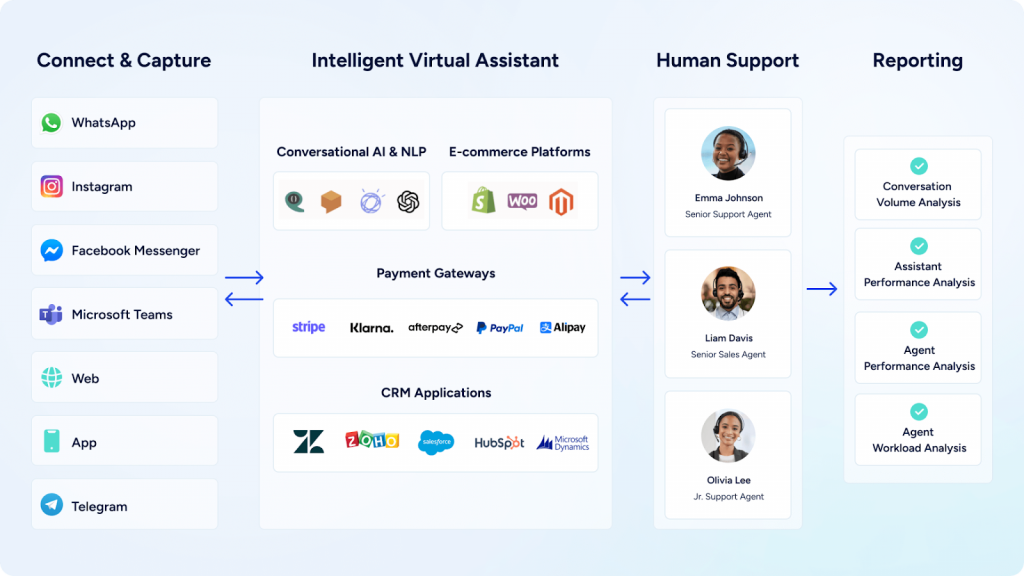
With Insider’s conversational AI, you can engage customers in meaningful, human-like exchanges on WhatsApp, Instagram, web, app, RCS, and beyond. Predictive and generative AI powers every message to ensure every message is relevant, timely, and uniquely tailored to each person.
Here are the key features of Insider’s conversational AI:
- Real-time personalization & AI-native recommendations: Using real-time data and machine learning, our AI solution recommends products, upsells, cross-sells, or offers content tailored to that person.
- Omnichannel coverage with unified context: Whether a user starts on WhatsApp, hops to Instagram DM, and later visits your app, the conversation thread stays connected. The best part is that Insider unifies that context across every channel.
- Drag-and-drop conversation design: You don’t need to be a developer to build these dialogues. Insider offers visual tools to map out conversation logic, flows, and triggers.
- Deep insights & analytics: You’ll see what’s happening across every interaction: which flows drive results, where drop-offs happen, how bots perform, and how human agents follow up. That feedback loop helps you sharpen your conversations over time.
With these capabilities, Insider transforms engagement from reactive to conversational. Every interaction becomes an opportunity to delight customers. Book a demo with our team or take a platform tour.
FAQs
From retail to banking, travel, and healthcare, almost every industry that relies on customer interaction can benefit from conversational AI. At Insider, we’ve seen brands like PUMA, Lenovo, and MAC use conversational experiences to connect with customers in more meaningful ways. Whether it’s helping shoppers discover products on WhatsApp, guiding a traveler through booking changes, or reminding a bank customer about loan eligibility, conversational AI helps brands engage faster, smarter, and at scale.
Unlike rule-based bots that respond to fixed keywords, Insider’s customer engagement platform uses Generative and Predictive AI to understand intent, emotion, and timing. It continues customer conversation across channels, remembers preferences, and adapts to each customer’s behavior.
Not entirely, and it shouldn’t. The best engagement strategies combine AI efficiency with human empathy. Insider’s platform is designed to automate high-volume, repetitive interactions while seamlessly handing off complex or sensitive cases to human teams.
When that happens, Insider passes along complete conversation histories and behavioral insights so the agent can step in with full context.
The biggest challenges around implementing conversational AI are usually in data quality, integration, and consistency. Many companies struggle to unify customer data across systems, which can limit how “intelligent” their AI really is.
Insider solves this with its AI-powered Customer Data Platform (CDP), which stitches together behavioral, transactional, and engagement data into a single profile. That unified foundation ensures every AI-driven conversation is contextually aware, compliant, and aligned with your brand tone from start to finish.
Insider’s conversational customer experience solution combines predictive analytics with generative AI to tailor every response based on who the customer is, what they’ve done, and what they’re likely to do next.
For instance, a returning customer on your app might receive a tailored recommendation for a product they browsed last week, while a new visitor might be guided through a first-time offer via WhatsApp. Each message is dynamic, data-informed, and delivered in the customer’s preferred tone, channel, and timing.