How AI Agents Are Replacing Traditional Chat Journeys

Updated on 4 Nov 2025
Table of Contents
Most Popular
Chatbots were once a breakthrough. They automated FAQs, reduced queue pressure, and gave support teams more time to focus on complex problems.
But today, customers expect more than just fast replies. They want real solutions: conversations that understand context, feel human, and move things forward. Whether they’re browsing for the perfect product or solving a service issue, they want interactions that respond with intent.
That’s something traditional chatbots were never designed to do.
Agentic AI bridges the gap between chatbot’s limitations and customers’ shifting needs.
These new-generation agents go beyond conversation. They comprehend. They sense emotion, understand nuance, and execute complete tasks autonomously while keeping interactions natural and human.
They’re not standalone bots; they’re connected systems that deliver faster, smarter outcomes across the business.
| Unlock endless possibilities with Agent One™Get a demo |
Chatbots vs. AI Agents: What’s the difference?
Chatbots follow commands. AI Agents achieve outcomes.
A chatbot is a conversational interface, often rules-based and sometimes powered by natural language processing (NLP), designed to handle simple tasks, such as FAQs, order status, password resets, booking a table, and linking you to a help article.
Agentic AI is goal-driven and autonomous by nature. It understands intent, reasons over context, plans multi-step workflows, and uses tools, such as APIs, databases, and even other software, to complete a task end-to-end.
By combining these capabilities and intelligent systems, Agentic AI handles a wide range of tasks autonomously, such as making product recommendations, troubleshooting problems, and engaging in follow-up interactions. This allows humans to focus on complex tasks that add value.
To help you understand how AI agents differ from chatbots and why the shift to agentic AI is a game-changer for customer engagement, here’s an example:
Let’s say a customer wants to return a product they purchased from your website. To help the customer return the product, a chatbot will politely point you to the return policy and stop there.
An AI Agent goes further. It guides the customer through the entire process, confirms order details, initiates the return, generates the shipping label, tracks the package once it’s sent, and updates the customer when the refund is processed—all without a single handoff.
If you’re still relying on chatbots to power your customer engagement strategy, now is the time to rethink what’s possible.
Why brands are replacing chatbots with AI Agents
Chatbots once promised efficiency. But their lack of contextual understanding made interactions predictable and, frankly, uninspiring.
When faced with multi-layered questions, most bots stumble. They can’t interpret nuance or handle ambiguity, forcing users to rephrase the same question repeatedly. Over time, that predictability became a friction point.
AI Agents turn that around. With adaptive reasoning, emotional intelligence, and integrated access to core tools and databases, they manage unpredictable scenarios with human-like flexibility.
And the timing couldn’t be better. McKinsey estimates that enterprise AI could unlock $4.4 trillion in annual value—but only if organizations rethink how work happens. Meanwhile, 85% of enterprises are expected to deploy AI Agents by 2025.
That’s a compelling reason for businesses to use AI Agents. The best part about using Agentic AI is its ability to manage unpredictable scenarios, adapt in real time, and collaborate with other agents to solve problems as they evolve.
Take Agent One, for instance. They help manage a significant portion of customer interactions while reducing overhead costs and keeping your operations smooth and efficient.
With the help of Agent One, your teams can focus on decision-making, creativity, and strategy.
3 real-world use cases: How Agent One is redefining AI interaction
Now that you know how autonomous AI works and why it’s so beneficial, let’s discuss the main use cases for this technology. Specifically, we’ll focus on three purpose-built autonomous agents that are part of Agent One.
1. Shopping Agent
Insider’s Shopping Agent is built to get shoppers to buy by inspiring confident decisions. It enables marketers to transform traditional search tools into a responsive, conversation-driven experience that feels human (unlike traditional chatbots with inflexible rule-based automations).
With emotionally tuned, personalized interactions, the Shopping Agent quickly grasps what customers want, offers spot-on suggestions, and boosts both their trust and lifetime value. This marks it invaluable for:
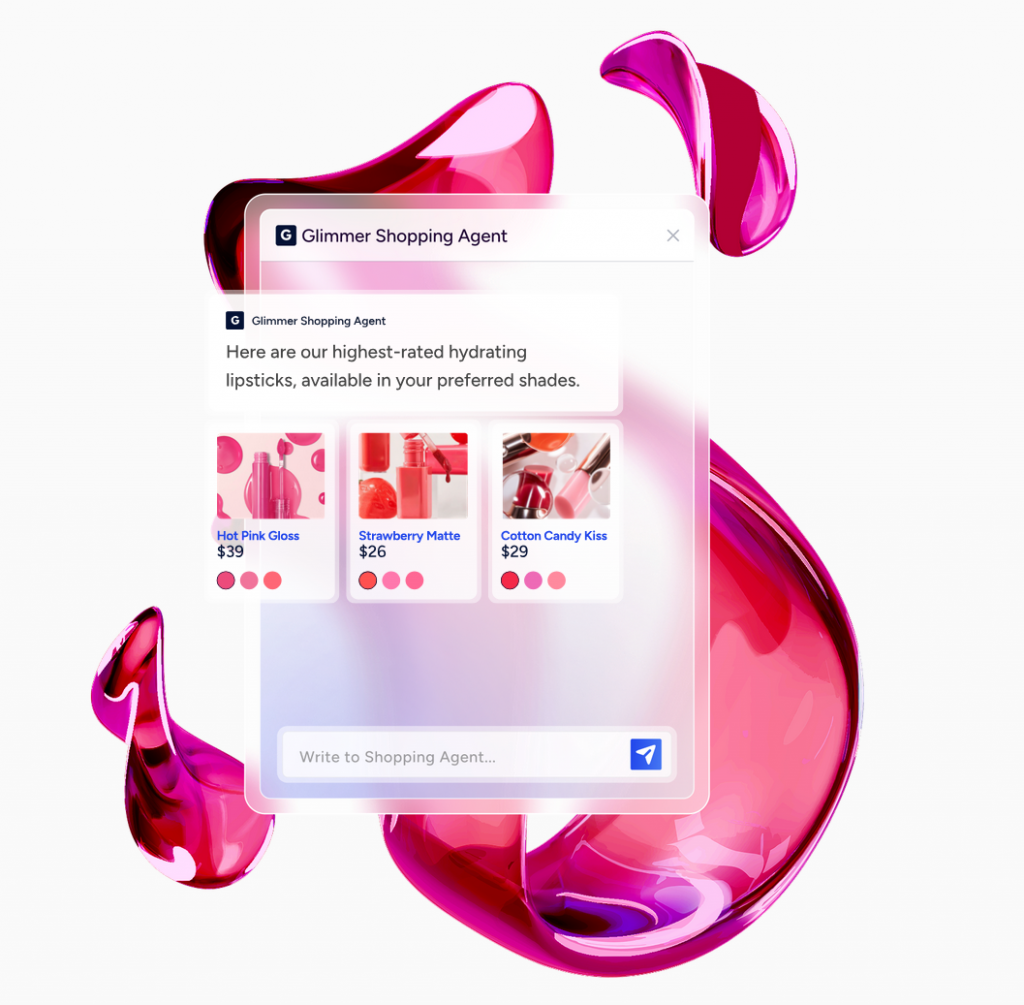
- Predicting what shoppers need before they ask. The agent can respond to user behavior instantly, holding one-on-one chats that gently steer buyers toward the products that best match their interests, making it easier and faster for them to find what they want.
- Boosting buying confidence. Shopping Agent offers tailored guidance during the decision-making process, so customers feel reassured, understood, and more likely to complete their purchase.
- Making every interaction count. Lastly, the agent can guide users beyond their original intent by introducing them to top-rated options, related add-ons, and curated picks that elevate their entire shopping experience.
Shopping Agent does all of these things by integrating with Eureka (our eCommerce site search platform), our enterprise CDP, and our existing AI recommendation models. As a result, it offers a complete solution that drastically improves product discovery.
2. Support Agent
Support Agent provides faster, more personal responses to customer queries across channels. Specifically, it delivers meaningful service experiences through a responsive, always-available assistant that leverages insights from your CDP, CRM, and more.
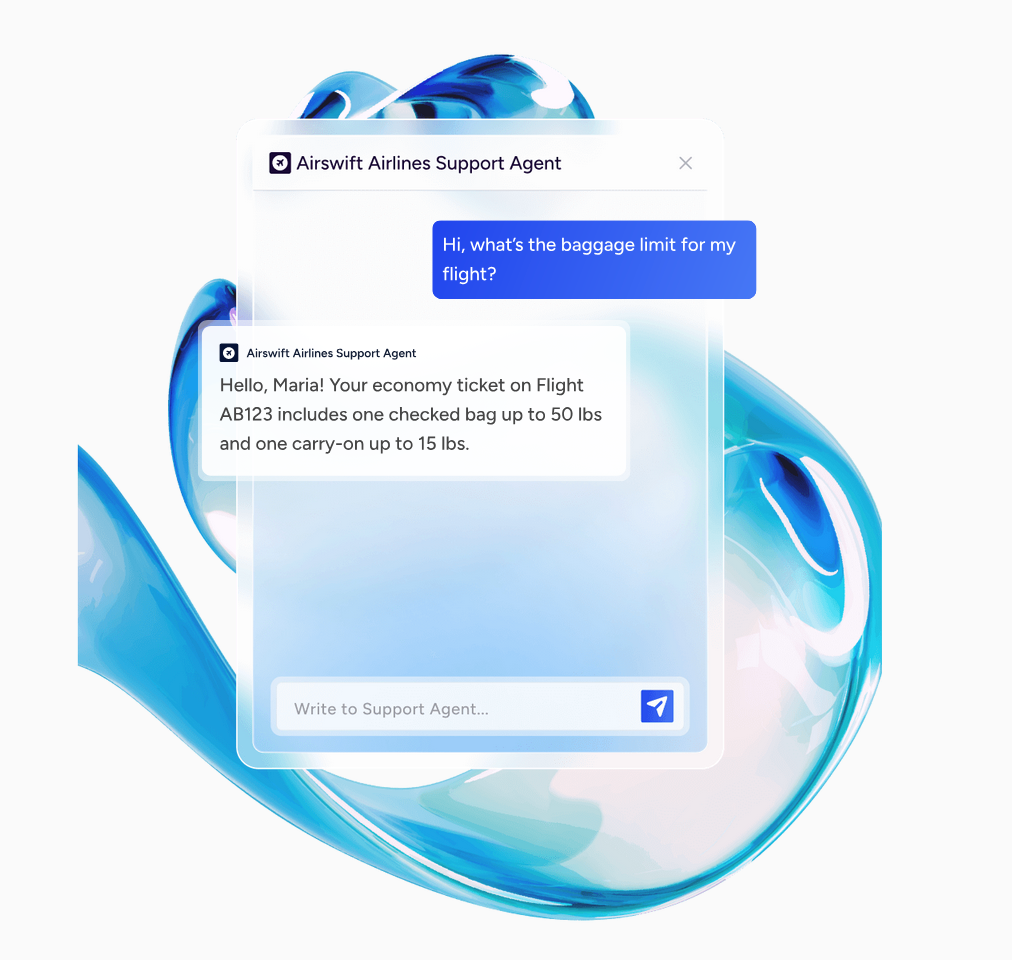
With built-in safeguards, the Support Agent adapts in real time, turning small moments into smooth, personalized support that earns trust and strengthens relationships.
In short, you can use Support Agent to:
- Run frontline service with autonomous intelligence. You can handle customer issues instantly using AI-powered support that’s always on, resolving questions across the full journey. You can also build rules for handoff to human support agents whenever necessary.
- Speed up outcomes through user-approved automation. Whether it’s processing returns or making changes to an account, the Support Agent can take action independently (always with customer consent) to make every step seamless.
- Earn trust through natural, informed interactions. The agent can deliver context-rich support experiences by tapping into full customer profiles through our CDP, which enables it to respond with awareness of customer mood, history, and intent in real time.
3. Insights Agent
Autonomous AI isn’t useful solely for engaging with customers. It can also help marketers uncover important insights and improve campaign performance.
That’s exactly what our Insights Agent does. It enables teams to create agile, data-informed journeys guided by live, actionable insights, instead of rushing under pressure and sacrificing outcomes.
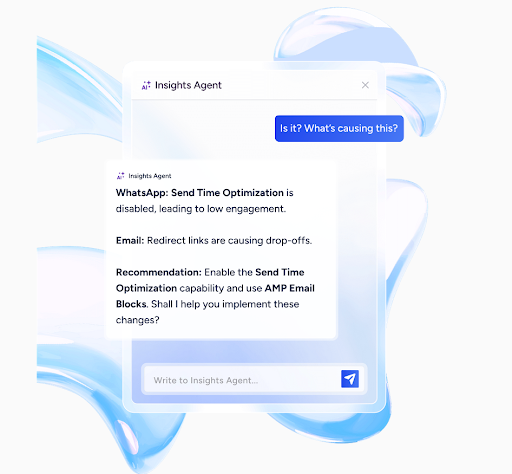
You can rely on Insights Agent to:
- Detect risks early and stay in control before they impact performance. With smart alerts and live data streams, you can enable quick course correction to keep campaigns optimized and engagement levels high.
- Uncover winning tactics across your campaigns without guesswork. Powered by Generative and Agentic AI, Insights Agent learns from success and adapts journeys automatically, helping you expand impact and deepen customer engagement.
- Tap into forward-looking insights on channel effectiveness, audience behavior, and seasonal patterns. Use these signals to fine-tune strategy and consistently improve campaign performance.
To learn more about our Agentic AI offerings, check out our website or schedule a demo with our team.
The real challenges behind moving from chatbots to AI Agents
Although switching from chatbots to Agentic AI offers huge benefits, businesses often encounter several significant challenges along the way. Let’s take a look at them:
1. Data and integration roadblocks: AI agents rely on clean, consistent, and interconnected data streams. Most organizations build on top of years (sometimes decades) of legacy systems and siloed data and when that data is fragmented or poorly structured, things break.
2. Fragility and technical brittleness: Even the most advanced foundation models are, at their core, brittle. A small prompt change or an API update can cause an agent to loop endlessly, fail to execute, or worse—hallucinate an action that was never intended. Given AI Agents depend on external tools and constantly evolving environments, maintaining stability is an ongoing challenge.
3. Risk of losing control and trust: Handing over decision-making power to AI requires governance. Without clear operational boundaries, multi-agent systems can overlap, conflict, or make opaque decisions that no one can fully explain. This can diminish both internal and external trust, especially when agents touch sensitive data or customer-facing systems.
4. Posing security and privacy threats: AI agents need access to vast amounts of data and external APIs, and that creates new vulnerabilities. Unauthorized data exposure, malicious manipulation, or model exploitation through jailbreak prompts can pose serious threats to the organization. Beyond that, organizations face bigger ethical questions, such as bias, job displacement, overreliance, and accountability when things go wrong.
How Agent One mitigates these challenges while leading the future of Agentic AI
Agent One is built to seamlessly integrate with your existing data ecosystem, intelligently connecting disparate and legacy data sources. Its advanced data orchestration ensures clean, consistent, and unified data flows, breaking down silos without requiring complete system overhauls.
This means your AI agents have the reliable, interconnected data they need to act effectively and accurately across diverse touchpoints.
By intelligently managing API dependencies and evolving environments, Agent One maintains agent stability and resilience, delivering consistent and precise execution even as your tech stack changes.
Governance is at the core of Agent One’s design. It enforces clear operational boundaries and role-based access controls to manage multi-agent workflows, preventing conflicts or decision overlaps.
Transparent audit trails and explainable AI capabilities foster deep trust internally and externally, allowing teams to confidently rely on AI agents — especially when handling sensitive customer interactions or critical decisions.
Whether Agent One is helping your shopper find exactly what they’re looking for without friction, resolving complex support issues without making them repeat themselves, or surfacing real-time insights that help marketers adjust campaigns before performance drops, each agent is engineered for action
From automating routing tasks to handling complex conversations with care and nuance, our agents can help your brand convert, retain, and delight customers.
Let’s take a comprehensive look at what Insider’s Agent One does:
- Integrate with relevant data sources, including unified customer profiles from our enterprise CDP.
- Anticipate customers’ needs, understand the intent behind their queries, and provide relevant product recommendations.
- Turn your web search engine into an intelligent answer engine that delivers personalized conversations.
- Incorporate Insider’s predictive AI and Smart Recommendations to show relevant products and deliver more cross-sell and upsell opportunities.
- Manage front-line support by answering customer questions accurately 24/7, powered by CDP, CRM, and other relevant data sources.
- Uncover campaign risks, make recommendations and optimizations autonomously, and anticipate trends to improve performance.
Brands like L’Oréal, Virgin, and Philips have seen measurable lifts, such as, faster resolutions, higher conversions, and retention curves that keep bending upward.
Want to see how Agent One turns every customer moment into a moment that lasts? Request a demo.