13 Best Marketing Automation Tools for SMBs and Enterprises

Updated on 10 Sep 2025
Table of Contents
Most Popular
Between planning campaigns, chasing approvals, and manually scheduling every post and email, marketing can feel less like strategy and more like spinning plates.
The more you grow, the more plates there are.
Different channels, different audiences, different offers, and one wrong move sends them crashing.
Spreadsheets can help you track it all. A good CRM might keep your contacts tidy. But neither actually runs your marketing for you.
That means you and your team are still stuck on the hamster wheel of repetitive tasks: sending follow-ups, segmenting lists, checking analytics, then starting all over again.
The right marketing automation platform changes all of that. It keeps your campaigns running, audience engaged, and data flowing, all while you focus on the creative work that actually moves the needle.
For small businesses, it works like hiring an extra set of hands without adding to payroll. For mid-sized companies, it’s the bridge from “working harder” to “working smarter.” For enterprises, it’s the only way to keep massive, multi-channel campaigns coordinated without losing speed or control.
There’s no shortage of marketing automation tools claiming to do it all.
But after testing the most popular options and a few under-the-radar standouts, we found 13 automation tools for each business’s needs. This article gives you a detailed look at the best marketing automation platforms worth your time.
How we chose the best marketing automation platforms for SMBs and enterprises
Before we go straight into which marketing automation tools can grow with you, match your pace, and keep your team focused, it’s worth stepping back to understand the unique battles marketing teams face at different company sizes.
We tested every platform with those realities in mind, because the challenges of an SMB look very different from those of an enterprise.
For small and medium businesses (SMBs):
- Scalable pricing and contact limits: Growing quickly is part of the SMB journey. You need platforms with pricing models that reward growth without steep penalties, whether that’s affordable entry-level plans with generous subscriber allowances or tiered pricing that scales smoothly as your contact list expands.
- User-friendly automation & segmentation: For small teams wearing multiple hats, automation needs to be intuitive and powerful. We looked for platforms where setting up automated journeys, behavioral triggers, and audience segments isn’t a coding nightmare but a straightforward, drag-and-drop experience that saves time and avoids frustration.
- Prebuilt templates & customization options: SMBs often lack dedicated design resources. The best platforms provide polished, easy-to-customize templates for emails, landing pages, and workflows. This helps teams launch professional campaigns quickly without reinventing the wheel.
- Integration capabilities: While SMBs might start simple, most want to connect marketing efforts to their CRM, ecommerce store, or analytics tools down the road. We favored platforms offering seamless, robust integrations that don’t require technical experts or long setup times.
- Onboarding and support: Ease of adoption matters. We assessed how well each platform guides new users from sign-up to campaign launch, including tutorials, customer support, and an interface that doesn’t ask you to “figure it out on your own.”
For enterprises:
- Real-time data integration & synchronization: Enterprises need platforms that handle real time customer data flows from multiple sources (CRMs, CDPs, commerce, and more), ensuring every automated message is triggered by the freshest insights.
- Advanced AI-powered personalization & predictive analytics: Basic automation won’t cut it. The right tool uses AI not just for personalization (beyond “Hi, [Name]”) but to predict customer behaviors, optimize send times, and deliver dynamically tailored content across every channel.
- Cross-channel campaign orchestration: Email is one piece of the puzzle. We emphasized platforms capable of coordinating complex workflows across email, SMS, push notifications, web personalization, WhatsApp, and voice channels – all managed from one central hub.
- Scalability & reliability at massive volumes: With millions of contacts and thousands of campaigns running simultaneously, enterprise platforms must guarantee high performance, 99.9%+ uptime, and fast, accurate segment updates without breaking a sweat.
- Granular role-based access & team collaboration tools: Large marketing teams require precise permission settings, approval workflows, centralized asset libraries, and multi-department coordination features to keep campaigns consistent and on brand.
- Comprehensive analytics & experimentation framework: Data drives enterprise decision-making. We prioritized platforms offering deep ROI reporting, integrated A/B and multivariate testing, and actionable recommendations for continuous campaign optimization.
- Security & compliance features: Meeting GDPR, CCPA, HIPAA, and other regulatory requirements is non-negotiable. The best platforms provide robust data governance tools, audit trails, and customizable compliance workflows.
With these criteria in mind, we picked 13 marketing automation platform tools. Let’s walk through a quick breakdown of each marketing automation tool, covering the key features, ideal use cases, drawbacks, and pricing details.
To make your decision easier, we’ve grouped the tools into categories based on which type of company they are best for, so that you can spot the right fit fast.
Marketing automation platforms for enterprises
1. Insider

Insider brings together the most extensive set of personalization and automation capabilities for websites and mobile apps, as well as for channels like email, SMS, push notifications, and WhatsApp.
Our platform has been ranked among the top solutions in various categories, including:
- Marketing automation platforms.
- Mobile marketing software.
- Personalization software.
- Customer data platforms.
- And more.
Thanks to the wide range of capabilities and native channels, over 1200 brands like Adidas, Vodafone, and Lexus use Insider for various use cases like:
- Automating flows and campaigns across all customer touchpoints from a single place using Architect, our cross-channel customer journey builder.
- Maximizing their marketing efforts and budget by consolidating their stack, instead of using a bunch of different automation and personalization tools for each channel.
- Increasing engagement, conversions, and revenue by automatically personalizing every customer touchpoint, including their websites, mobile apps, email, SMS, WhatsApp, push notifications, and more.
Let’s take a detailed look at Insider’s core offerings:
Enable true cross-channel automation
Insider supports over 12 marketing channels natively, including websites, mobile apps, SMS, WhatsApp, email, push notifications, and others shown in the screenshot below.
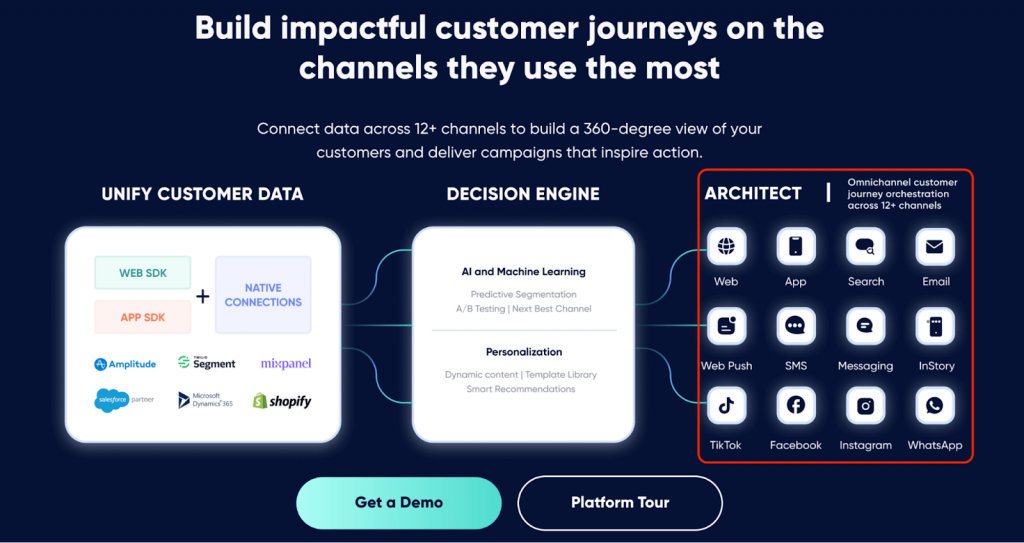
Because these channels are built into our platform, you don’t need a third-party solution to automate messages or campaigns on them. This can help you drastically simplify your marketing stack, streamline operations, and maximize your marketing budget.
However, Insider doesn’t just let you reach customers on these channels. With our platform, you can synchronize your efforts across all touchpoints to create a truly consistent experience for your customers.
For example, say a customer showed interest in a certain product category and price range on your site. You can use that information to:
- Automatically send them a web push notification with relevant product suggestions.
- Set up an automated email campaign for customers who didn’t buy after seeing the push notification.
- Expand the journey to other channels by automatically sending messages with discount codes on channels like SMS or WhatsApp.
- The key here is that each subsequent message can take into account how the customer reacted to the previous one. This cross-channel marketing approach ensures your messages and branding are always consistent, which produces higher engagement and more conversions.
This is possible thanks to Insider’s ability to consolidate all your customer data in our CDP (which comes free with our platform) to reveal each user’s:
- Purchase history
- Channel reachability.
- Preferred channels and times to interact with your brand.
- Predicted behaviors (e.g., likelihood to purchase or churn).
- All interactions with your brand across your website, mobile app, and external communication channels.
For example, the screenshot below shows a unified customer profile in Insider’s CDP that contains all these insights.

However, if you already have your data consolidated in another CDP like Segment or Amplitude, Insider can simply connect to it. That way, our platform can use the data to help you build and automate high-converting campaigns, without you having to stop using your current CDP.
Trigger automations after specific actions, periods of time, and much more
Insider makes it easy to build automated flows and campaigns for all sorts of use cases. For example, you can use our solution to create:
- Standard email purchase confirmation and order update flows.
- Cross-sell and upsell campaigns on messaging channels like SMS or WhatsApp.
- Cart or browser abandonment automations via cost-effective web push notifications. Note: Vodafone used on-site cart reminders to increase conversion rates by 159%.
Complex cross-channel marketing campaigns that are personalized to each customer’s preferences. You can set up these and other automations with our journey orchestration tool called Architect.
This tool lets you build automated flows and campaigns (called Journeys) using a simple drag-and-drop editor.
You can use three types of audiences to build highly-targeted campaigns:
- Standard audiences: These include 120+ attributes, like locations, devices, operating systems, demographics, behaviors, preferences, and more.
- Predefined audiences: These are automatically created audiences who abandoned their carts (or a product page), made a purchase over a specific period of time, interacted with your brand on a specific channel, and others shown below.
- Insider predefined audiences
- AI-powered predictive audiences: This option lets you utilize our AI-powered intent engine to target users based on their discount affinity, projected spending, likelihood of purchase or churn, customer lifecycle status, and much more.
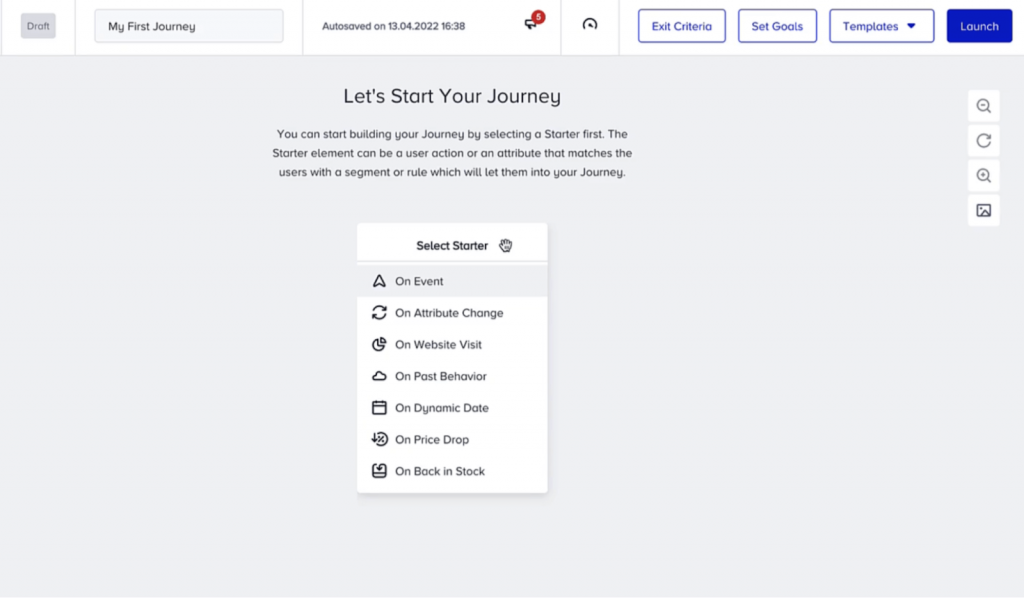
Note: The “Call an API” option lets you extend your reach even further to systems like Intercom or Zendesk, for example.
For more details, tactics, and examples of Architect in action, check out the articles below:
- 8 proven ecommerce marketing automation strategies and tools.
- How to use omnichannel marketing automation (with examples).
For a real-life example, you can refer to our case study with beauty and cosmetics brand Clarins. They used Architect to deliver relevant and personalized experiences on the channels their customers use, leading to a 45% increase in lead capture, a 4% uplift in conversion rates, and a 30x ROI in 12 weeks of using Insider.
Make smart decisions with built-in A/B testing
Besides relying on Insider’s AI-powered capabilities to optimize your journeys, you can also run A/B tests to compare any variables you like from subject lines, images, and body copy to different channels (e.g., email vs. SMS) and entire flows.
As you can see below, setting up even complex A/B tests is quick and easy with the drag-and-drop editor.
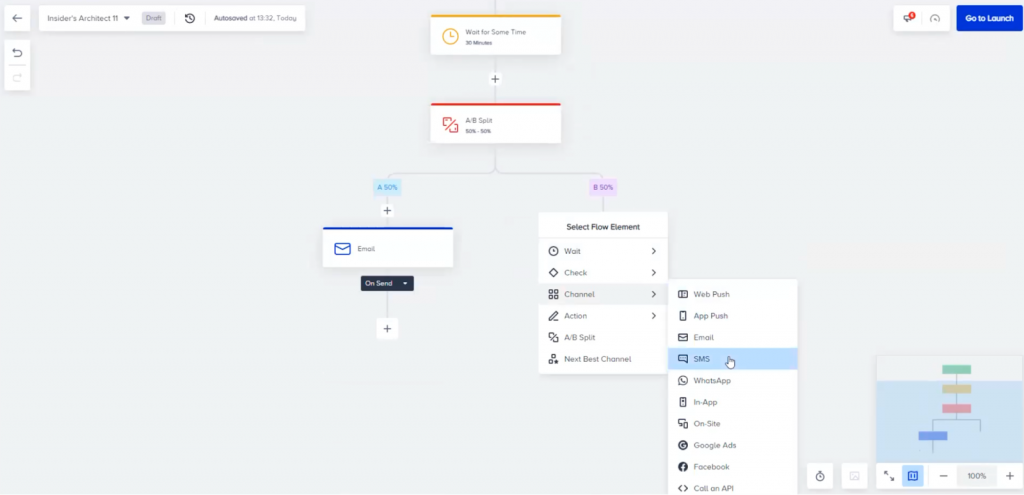
Additionally, Insider’s A/B Testing Winner-Autoselection feature can save you lots of time and effort when determining your test’s results.
This feature automatically detects and directs users to the winning path in your A/B tests using our machine learning algorithms. The selection is based on two criteria you select beforehand:
- A winning metric for the test, like open rate, conversion rate, revenue, and so on.
- Calculation duration, which is the time over which the winning metric is calculated and the winning path is announced (e.g., 30, 60, or 90 days).
- With this feature enabled, you don’t have to worry about manually analyzing each test and adjusting your automations based on the results.
You can speed up your tests (and campaign creation in general) by also using our ChatGPT-powered AI capabilities to automatically generate engaging copy for your messages, including subject lines, body text, and more.
Analyze your automation strategy with advanced analytics
Once it’s set up, Insider will give you a detailed overview of your entire user base, including:
- Number of known and unknown users.
- Channel reachability.
- And other key metrics.

From here, you can start digging deeper into your analytics data by focusing on specific segments, channels, or journeys.
For example, after launching an automated campaign, you can analyze its results in real time right in the journey builder to see how many people entered each step, where drop-offs occur, and which channels produced the best results.
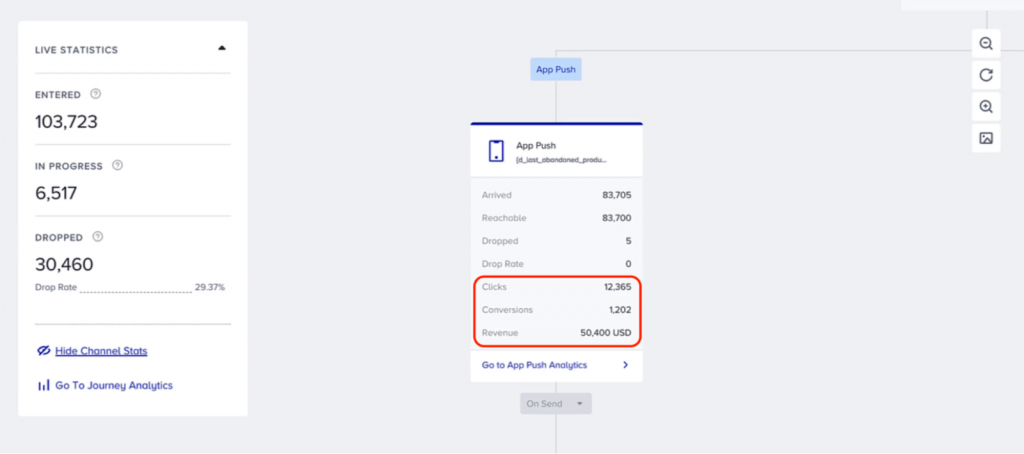
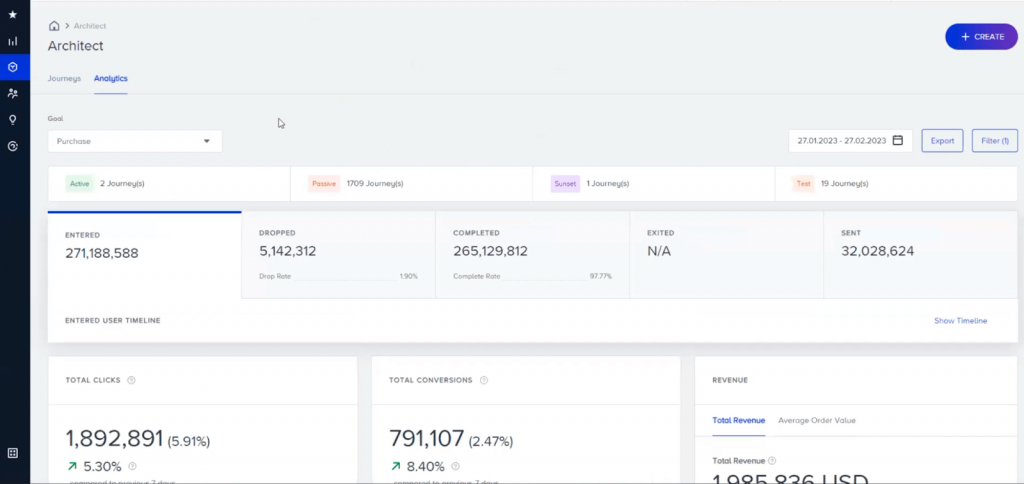
There’s even a more granular view of all your automated journeys (or just select ones) in the dedicated Architect analytics dashboard.
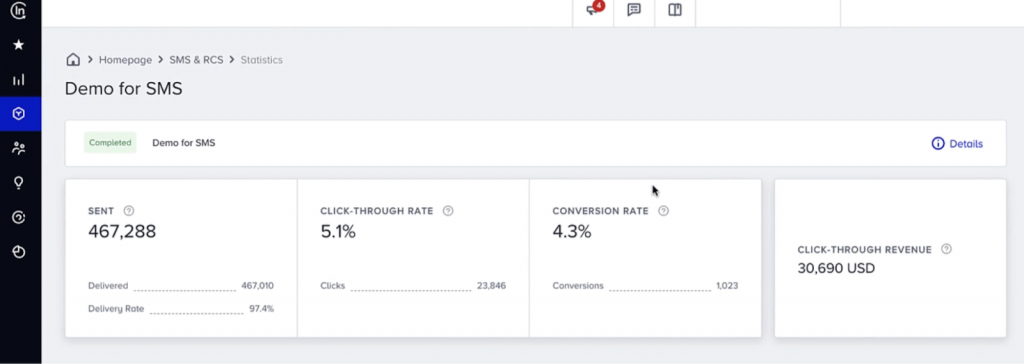
You can also drill down into specific channels and analyze their individual open rates, click-through rates (CTR), conversion rates, and other essential metrics.
Lastly, you can build custom dashboards for different teams inside your organization.
For example, you can have detailed dashboards for marketers interested in metrics like open rates, CTR, and channel reachability and simpler ones for stakeholders and C-level executives who are primarily focused on revenue and acquisition costs.
2. Salesforce Marketing Cloud
Salesforce Marketing Cloud (SFMC) is a powerhouse in enterprise marketing automation, designed to handle complex, large-scale marketing operations with cross-channel reach and deep personalization. This section is an expanded, candid overview that can help your audience make an informed decision about whether Salesforce Marketing Cloud is the right choice for their marketing needs.
Here are its key strengths:
- Customer data aggregation (Customer Data Platform – CDP): SFMC unifies data across CRM, digital interactions, offline channels, and third-party systems into a single customer profile. This comprehensive view powers highly personalized campaigns and improves segmentation precision.
- Cross-channel campaign orchestration: With Journey Builder and Automation Studio, you can design multi-step, adaptive campaigns spanning email, SMS, push notifications, social media, advertising, and even IoT triggers. These workflows update in real time based on customer behavior, ensuring your brand stays relevant across each touchpoint.
- Advanced AI & predictive analytics: Powered by Salesforce Einstein AI, Marketing Cloud offers predictive insights such as the best time to send messages, which customers are most likely to engage or convert, and content recommendations tailored to individual preferences. AI-driven automation goes well beyond simple personalizations to optimize campaign performance dynamically.
- Content & asset management: Content Builder streamlines the creation and collaboration on email templates, images, and marketing assets within one centralized hub, promoting brand consistency while accelerating campaign launches.
- Loyalty & account engagement: Through integrated tools like Pardot for B2B focus, and loyalty program management features, SFMC extends its reach to nurture leads, onboard customers, and foster long-term loyalty at scale.
- Data visualization & reporting: Analytics Builder and Datorama Intelligence offer dashboards, custom reports, and cross-channel performance tracking. These tools provide in-depth ROI analyses and help marketers continuously refine strategies through real time data.
- Extensive integrations: Seamless syncing with Salesforce Sales Cloud, Service Cloud, Commerce Cloud, plus external platforms such as Facebook, Google, LinkedIn, and more, ensures that your marketing efforts reflect the latest customer behaviors and transactions.
Pricing and challenges:
- Given its depth and breadth, Salesforce Marketing Cloud demands significant training and expertise. End users often need dedicated admins or consultants to manage configurations.
- The platform’s pricing reflects its enterprise capabilities and can be cost-prohibitive for small to mid-market businesses. Budget planning should consider licensing, consulting, and ongoing administration.
- While powerful, connecting SFMC with existing systems can be technically challenging and slow without proper resources.
- Some users report occasional slowdowns during peak times and mixed experiences with customer support responsiveness.
3. Adobe Experience Cloud
Adobe Experience Cloud integrates several specialized products that together offer a comprehensive marketing automation ecosystem:
- Marketo Engage: The linchpin for B2B and B2C marketing automation, Marketo Engage empowers teams to automate repetitive tasks, nurture leads effectively, and build highly targeted audience segments using AI-driven insights. It helps marketers craft personalized, cross-channel campaigns that dynamically adapt as customer behavior evolves. Features include multi-step campaign workflows, lead scoring, predictive content recommendations, and native CRM integration to align marketing and sales efforts seamlessly.
- Adobe Campaign: Focused on cross-channel campaign management, Adobe Campaign provides granular orchestration for email, SMS, push notifications, direct mail, and more. It supports complex customer journeys and integrates deeply with Adobe’s customer data platform to enable real time audience targeting. Its strength lies in its ability to centralize campaign execution while maintaining high customization and compliance safeguards, making it ideal for enterprises managing volumes of personalized communication across channels.
- Adobe Target: This product drives A/B testing, multivariate testing, and AI-powered personalization at scale. Adobe Target lets marketers optimize web, mobile, and email experiences by tailoring content and offers based on user attributes, behavior, and predictive models. By continuously experimenting and learning, marketers can increase conversion rates and engagement, supported by AI that recommends the best experiences for each segment.
Considerations and challenges:
- Complexity and Steep Learning Curve
Adobe Experience Cloud is feature-rich but can be overwhelming for teams without dedicated resources. Implementations typically require strategic planning, technical expertise, and ongoing training to unlock full value. - Higher Cost and Investment
Pricing is often on the higher side, with enterprise contracts. Budget-conscious teams need to weigh costs against the comprehensive capabilities and scale benefits. - Implementation Time
Large-scale deployments may take weeks or months when integrating multiple Adobe products or syncing with legacy systems. - Potential Overlap with Existing Tools
Organizations already using other CRM or marketing tools might find some feature overlap. A clear integration and transition strategy is essential.
4. Oracle Marketing Cloud
Oracle Marketing Cloud, often represented by its flagship product Oracle Eloqua, is a comprehensive marketing automation platform designed to help enterprises execute data-driven, personalized, and multi-channel marketing campaigns at scale. Here’s a detailed overview of its capabilities, strengths, and what makes it a significant player in the marketing automation space.
Oracle Marketing Cloud is a powerful, enterprise-focused marketing automation platform that excels in multi-channel campaign orchestration, advanced personalization, and data-driven marketing insights. It’s particularly suited for organizations that need a scalable, secure, and deeply integrated tool to manage complex customer journeys and marketing workflows at scale.
Here are its key strengths:
- Enterprise-grade robustness: Ideal for large organizations that require complex, multi-channel campaign orchestration and a unified view of customer data.
- Extensive integration ecosystem: Strong native integration with Oracle CX Cloud Suite and popular CRMs ensures seamless data flow.
- Advanced targeting and personalization: AI and machine learning enhance segmentation and personalization beyond basic automation.
- Comprehensive reporting: Enables data-driven decision-making with deep analytics and attribution modeling.
- Automation at scale: Supports sophisticated workflows that can handle vast customer lists and complex triggers.
Pricing and drawbacks:
- Due to its extensive capabilities, the platform can be complex to implement and requires a well-trained marketing and technical team.
- As an enterprise solution, pricing tends to be high and may include additional fees for onboarding and premium modules.
- Large-scale integration and setup can be resource-intensive and time-consuming.
5. Braze
Braze specializes in real time customer engagement and lifecycle marketing automation, with a particular strength in mobile and multichannel messaging. It provides tools to build personalized customer journeys across email, push notifications, SMS, in-app messages, and more, with behavioral triggers.
Enterprises or fast-scaling mid-market brands that prioritize immediate, behavior-driven engagement across channels, especially those with mobile-centric customer bases requiring precision marketing.
Here are its key strengths:
- Highly intuitive UI and powerful segmentation capabilities based on behavior and lifecycle stages.
- Strong capabilities for lifecycle marketing and retention with real time triggers.
- Excellent for brands focused on mobile-first engagement and omnichannel consistency.
- Deep analytics and AI-powered experimentation to optimize campaigns.
Pricing:
- Price can be a barrier for smaller companies, aimed more at mid-market and enterprise levels.
- Some users note that the reporting depth can sometimes be shallow and advanced features may require integrations with other tools. Complexity in setup and customization can be challenging without a strong technical team.
Marketing automation platforms for SMBs
6. HubSpot Marketing Hub
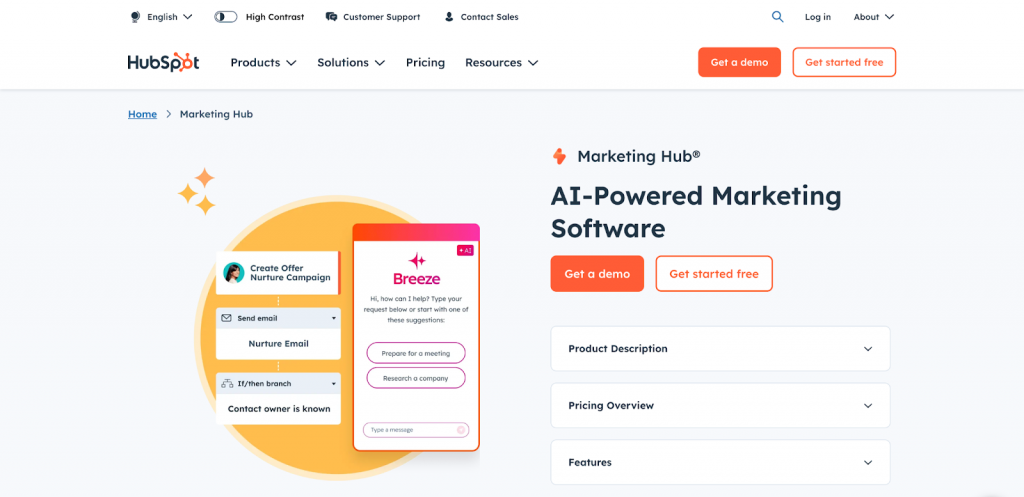
HubSpot Marketing Hub is a robust marketing automation solution tailored primarily for growing teams and enterprises that need a comprehensive, scalable platform. This section is an expanded look at what it offers, helping you decide if it fits your business needs.
Key Features and Capabilities:
- Visual workflow builder: HubSpot provides a drag-and-drop visual board for building conditional workflows that automate marketing actions based on user behavior, lifecycle stages, or custom triggers. This makes complex automation accessible without heavy coding – ideal for marketers who want flexibility combined with ease of use.
- Multi-channel automation: It doesn’t just automate emails. Marketing Hub supports automation across email, live chat, and on-site interactions, enabling you to nurture leads and engage customers in real time on various touchpoints. Automated sequences can include follow-ups, lead scoring, and personalized content delivery.
- Seamless CRM integration: Tightly integrated with HubSpot’s own CRM and other internal sales tools, it allows marketing and sales teams to align closely. This means workflows can automatically add leads to sales sequences or update contact properties, bridging gaps between marketing and sales effortlessly. It also supports integrations with third-party platforms, expanding its automation reach.
- Comprehensive marketing suite: Beyond workflows, the platform offers tools for content optimization (blogs, landing pages, CTAs), social media scheduling, SEO, ad management, and reporting – all integrated within Marketing Hub. This holistic approach helps keep marketing efforts unified under one roof.
Pricing and drawbacks:
- HubSpot offers a free plan and a low-cost Starter tier, which are great for testing or very small teams. However, complete and advanced automation features only come with the Professional and Enterprise plans, which are significantly more expensive and geared towards active marketing teams with serious contact volumes.
- Professional plans start around $900+ per month (with onboarding fees around $3,000), covering 2,000 contacts and a set number of user seats. Enterprise plans scale up in both features and price (with onboarding fees around $7,000), designed for large organizations with extensive marketing and automation needs. Additional contacts and users increase costs substantially.
7. ActiveCampaign
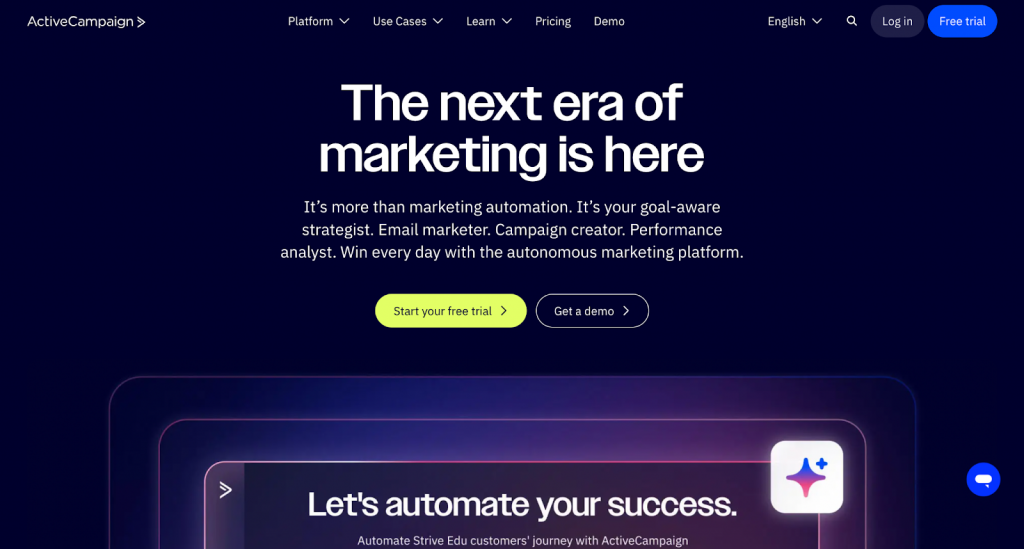
ActiveCampaign is a popular marketing automation and CRM platform widely used by small, medium, and growth-stage businesses for automating customer communication, managing relationships, and driving personalized campaigns across email, SMS, chat, and more.
ActiveCampaign stands out as a versatile and affordable marketing automation platform. It is strong for SMBs and growing companies moving toward more sophisticated automation. It balances ease of use with powerful CRM and multi-channel marketing features. The tiered pricing model allows you to pay for what you need, scaling automation complexity as your business grows.
Here are its key strengths:
- Comprehensive marketing automation: Includes a drag-and-drop builder for creating automated email sequences, behavioral triggers, multi-step workflows, conditional actions, and dynamic content.
- CRM and sales automation: Built-in CRM capabilities allow teams to manage leads, sales pipelines, and engage customers with automated follow-ups and sales tasks.
- Segmentation and personalization: Advanced segmentation options help target audiences by behavior, lifecycle, demographics, and predictive scoring (in higher plans).
- Multi-channel engagement: Supports email, SMS campaigns, site messaging, and integrations with chat tools and external platforms to orchestrate multichannel communication.
- AI features: Some plans unlock AI-enhanced features like predictive sending, advanced segmentation, and content recommendations to boost automation effectiveness.
- Templates and forms: Provides prebuilt email templates and customizable forms for lead capture and conversion optimization.
- Analytics and reporting: Tracks campaign performance, conversion attribution, and customer journey insights, with more advanced reporting on higher-tier plans
Pricing :
- ActiveCampaign’s pricing starts at $19/month for basic email marketing, automation, CRM, drag-and-drop editor, A/B testing, site tracking, and a 10,000 contact limit. Pricing scales with contacts; larger lists add significant monthly costs.
- 14-day free trial available with Pro features for testing.
- Offers free online training, onboarding, community support, and templates.
8. Emarsys
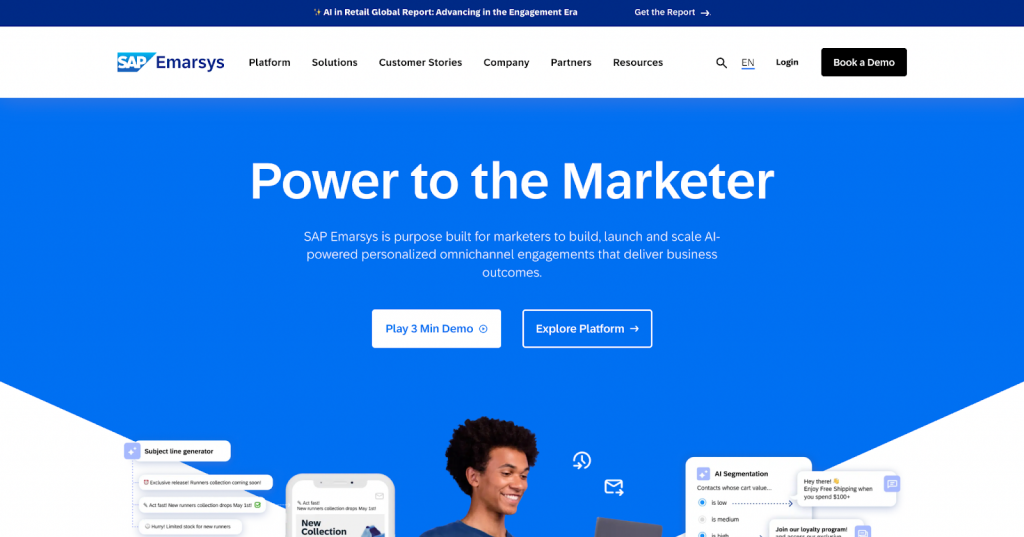
Emarsys, now under SAP, is a powerful omnichannel marketing automation and customer engagement platform designed primarily for mid-market to enterprise brands, with a strong focus on retail, e-commerce, and direct-to-consumer businesses. It offers AI-driven personalization, lifecycle marketing, and multi-channel orchestration (email, mobile, ads, direct mail, and web).
Marketers in fast-growing ecommerce or retail sectors that need scalable, AI-enhanced omnichannel automation with deep personalization and loyalty features. If the budget is less restrictive and you want advanced AI-driven engagement, Emarsys is a good choice.
Here are its key strengths:
- Unified customer data platform with open architecture enabling integrations across multiple data sources.
- AI-powered predictive analytics to optimize campaigns and personalize at scale.
- Pre-built, customizable omnichannel customer journeys to accelerate time-to-market.
- Strong emphasis on lifecycle marketing, customer loyalty programs, and marketing ROI.
- Highly rated for its marketer-friendly interface and support for real time data-driven decisions.
Pricing and drawbacks:
- Pricing is on the higher end, typically suited to enterprises or businesses with large contact bases and complex marketing needs.
- Implementation and onboarding can take several months, requiring a dedicated team to maximize ROI.
- Some users report slower feature rollouts and high costs for smaller businesses.
9. Iterable
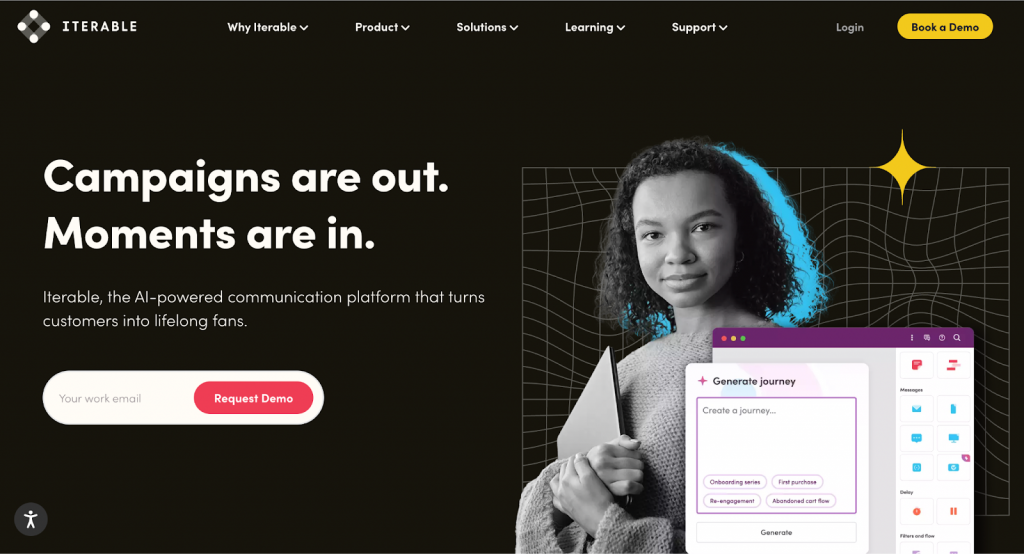
Iterable is a user-friendly, cross-channel marketing automation platform popular among mid-market to enterprise companies aiming for scalable lifecycle marketing. It orchestrates campaigns across email, SMS, push notifications, in-app messaging, and more, focusing on customer journey orchestration with real time data.
Marketing teams that want a flexible, scalable platform with strong multi-channel orchestration and testing capabilities. Particularly good for companies emphasizing customer lifecycle journey marketing and having the resources to manage a slightly steeper learning curve.
Here are its key strengths:
- Clean, intuitive interface with a drag-and-drop workflow builder enabling marketers to build complex, event-driven campaigns without heavy IT support.
- Strong support for experimentation via A/B and multivariate testing.
- Good scalability for large contact volumes and real time engagement workflows.
- Integrates well with CRM and CDP solutions for unified customer data.
Pricing and drawbacks:
- Pricing is custom and can be high, often tailored for mid to large enterprises.
- There are some drawbacks as well. Beginners need to go through a steep learning curve compared to some competitors. Some features may require professional services or advanced technical skills for full utilization.
10. Klaviyo
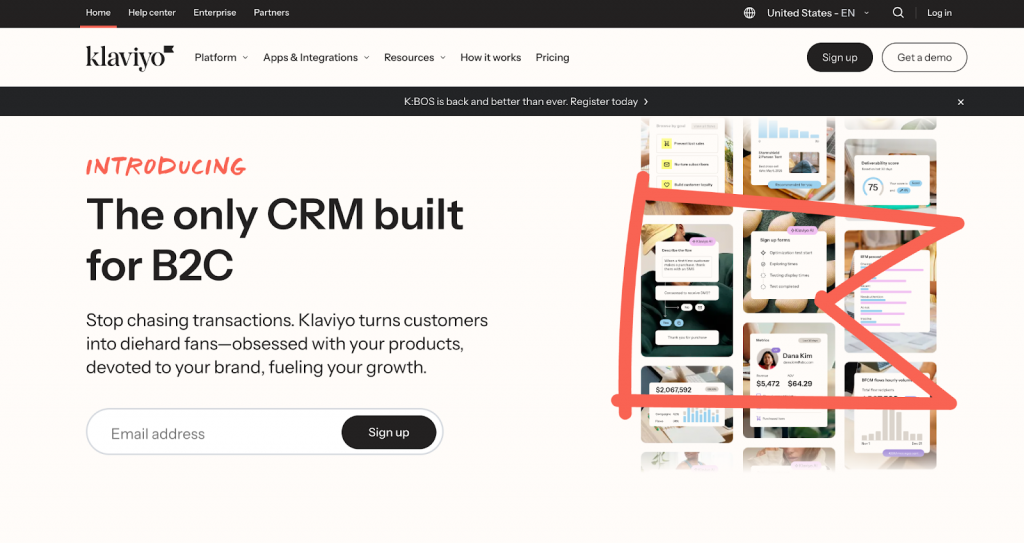
Klaviyo positions itself as a premium marketing automation and B2C CRM platform, particularly favored by ecommerce businesses and consumer brands striving for personalized, data-driven marketing at scale. It combines email, SMS (available in select countries), and push notifications within a unified automation and analytics framework.
Marketers in ecommerce or consumer brands who want deep automation, excellent customer insights, and multi-channel messaging with scalable AI personalization. It may be less ideal for non-ecommerce or smaller teams due to cost scaling.
Here are its key strengths:
- Unified data platform: Klaviyo aggregates customer data across channels to create rich profiles that fuel segmentation and personalized automation.
- Powerful Email & SMS marketing: Offers advanced automation flows, behavioral triggers, predictive analytics, and AI-driven tools like subject line generators, included even in the free plan.
- Generous free plan: Allows up to 1,000 contacts and 12,000 emails/month with access to AI tools, which is rare among premium platforms.
- Real-time segmentation & reporting: Dynamic audience segmentation based on real time activity and deep marketing analytics guides continuous optimization.
- ecommerce focus: Integrates seamlessly with major ecommerce platforms like Shopify, Magento, and BigCommerce.
Pricing:
- Klaviyo offers a free tier that supports up to 1,000 contacts with basic automation.
- Its paid plans start at around $20/month for 500+ contacts, scaling steeply with contact and email volume.
- SMS marketing is charged via credits and is available only in specific countries, which limits global reach.
- If contact hygiene isn’t maintained, recent pricing updates emphasize that billing on active profiles can surprise some users with higher-than-expected bills.
11. Mailchimp
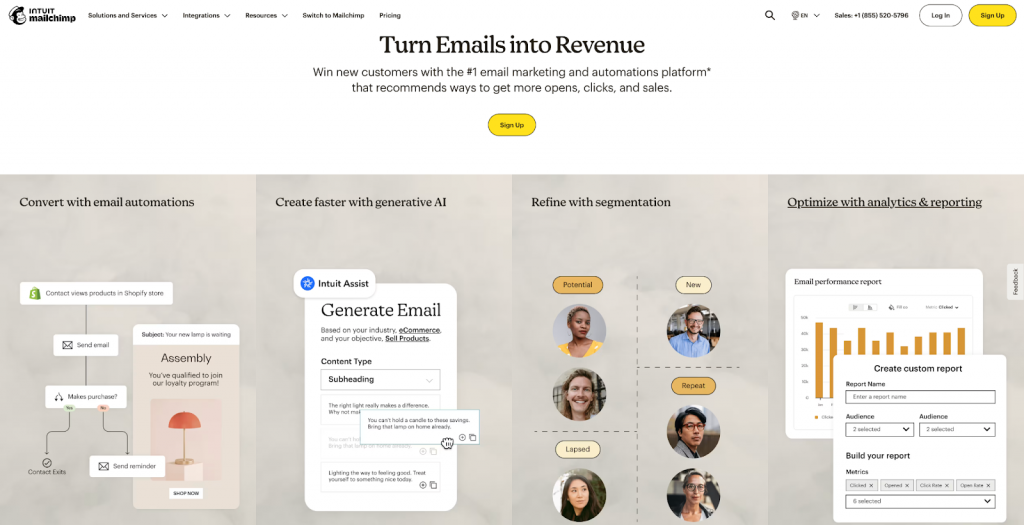
Mailchimp is one of the earliest and most popular email marketing platforms, known for its user-friendly drag-and-drop email builder and all-in-one marketing tools for small businesses.
Small businesses or agencies looking for a cost-effective, straightforward email marketing tool with growing automation. Mailchimp is not ideal for enterprises or those needing highly advanced segmentation or AI capabilities.
Here are its key strengths:
- Intuitive user interface: Easy for beginners to create campaigns quickly without much technical skill.
- Marketing automation: Supports automated workflows, behavioral triggers, and email sequences suitable for small to medium businesses.
- Multichannel marketing: Beyond email, it allows website building, landing pages, postcards, and basic CRM features.
- AI Features: Includes AI-powered subject line recommendations and content suggestions.
- Strong support ecosystem: Large user base with extensive tutorials, templates, and customer support.
Pricing:
- Mailchimp offers a free plan available for up to 500 contacts and 1,000 emails per month.
- Its paid plans start at around $13/month, depending on contacts, with premium tiers adding more automation and multichannel capabilities.
- Pricing remains relatively accessible for small to midsize teams.
12. Brevo
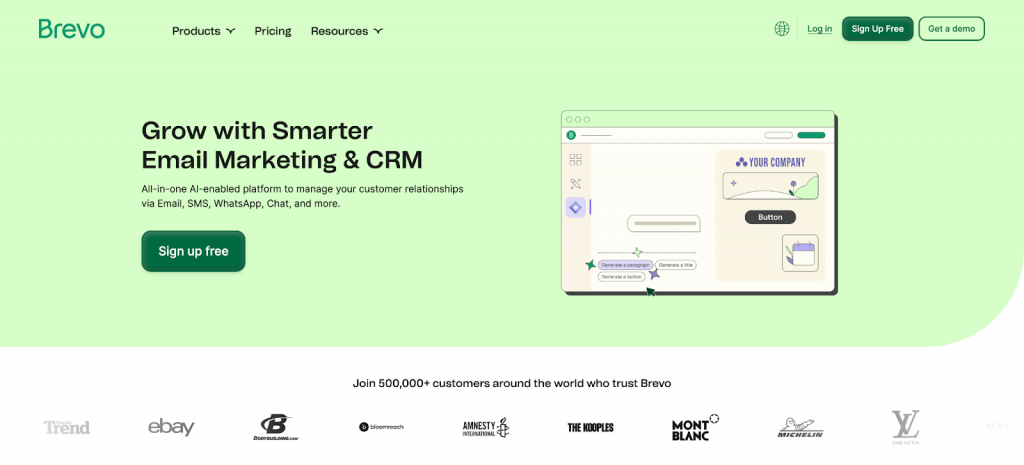
Brevo brands itself as a multi-channel marketing platform and CRM combining email, SMS, WhatsApp, live chat, and chatbots in one suite, focusing mostly on SMBs but offering enterprise-grade options as well.
Small to medium businesses want affordable, all-in-one communication tools spanning email, SMS, and messaging apps with automation. So Brevo is a good pick for teams needing simple CRM and chat functionality integrated with marketing.
Here are its key strengths:
- Multi-channel capability: Email, SMS, and WhatsApp alongside live chat and chatbot automation to engage customers in real time.
- CRM suite: Includes basic CRM features, signup forms, and landing page builders.
- Automation editor: User-friendly campaign automation workflows with triggers based on customer behavior.
- Enterprise offering: BrevoPlus includes dedicated onboarding and customer success resources for larger businesses.
Pricing:
- Brevo offers a free tier that includes up to 300 emails/day with unlimited contacts, but with some feature limitations.
- Its paid plans start at about $25/month for 20,000 emails/month and scale with volume.
- The enterprise plans are custom-priced for higher volume and advanced feature access.
13. Omnisend
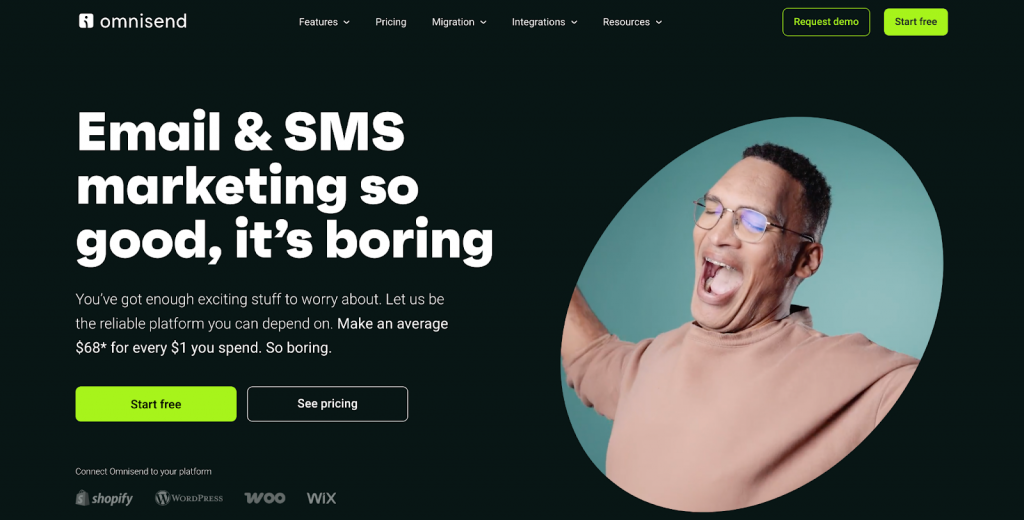
Omnisend is an ecommerce-focused marketing automation with built-in support for email, SMS, and web push notifications to boost customer engagement and conversions. ecommerce brands and small businesses who want a simple, effective automation platform focused on driving sales via email, SMS, and push notifications without high complexity or cost.
Here are its key strengths:
- ecommerce integration: Deep connection with platforms like Shopify and BigCommerce for seamless data-driven automation.
- Multi-channel automation: Supports email, SMS, and web push campaigns in coordinated flows.
- User-friendly: Easy-to-use automation builder suited for teams new to marketing automation.
- Advanced segmentation: Allows targeting based on behavior, purchase history, and engagement patterns.
Pricing:
- Omnisend offers a free plan with basic email marketing and up to 15,000 emails/month (500 emails/day).
- Its paid plans start around $16/month for 500 contacts, with features and volumes scaling in line with pricing.
Build, personalize, and automate high-converting campaigns across all channels with Insider
If you’re a fast-growing mid-sized or enterprise brand, chances are your customer communications are spread across a dozen tools and touchpoints. Insider brings them all together, so you can automate and personalize every interaction, whether it’s on your website, mobile app, email, SMS, WhatsApp, Facebook Messenger, or beyond.
Here’s what that means in practice:
- All your customer data, finally in one place. Insider pulls information from your CRM, CMS, analytics tools, and even offline sources into a single, accessible view.
- A complete picture of every customer. Unified 360° profiles let you see behaviors, interests, and preferred channels at a glance, so all your campaigns feel personal, not generic.
- Predictive insights you can act on instantly. Our AI-powered intent engine surfaces patterns before they happen, from projected spend to churn risk, so you can respond in real time.
- Faster, proven execution. Tap into a library of ready-to-use templates and best practices, with hands-on guidance from our team to help you launch and optimize campaigns quickly.
If you’re ready to see what unified, AI-powered automation could look like for your business, book a personalized demo and explore how Insider can help you connect with customers at every stage of their journey.